
Fibonacci Retracement: A Complete Guide for Indian Stock Market Traders

What is Fibonacci Retracement?
Fibonacci Retracement is a technical analysis tool used to identify potential support and resistance levels during a price correction within a larger trend. The levels are derived from the Fibonacci sequence — a mathematical series where each number is the sum of the two preceding ones (0, 1, 1, 2, 3, 5, 8, 13, 21…).
These ratios appear throughout nature, architecture, and financial markets, where human behavioral patterns create repetitive price structures. Indian traders extensively use Fibonacci levels to plan entries, exits, and stop-losses — especially during corrections in Nifty bull markets.
The Fibonacci Ratios
| 23.6% | Shallow retracement — strong trend, minor pullback | |
| 38.2% | Moderate retracement — healthy correction in an uptrend | |
| 50.0% | Psychological midpoint — not a true Fibonacci but widely watched | |
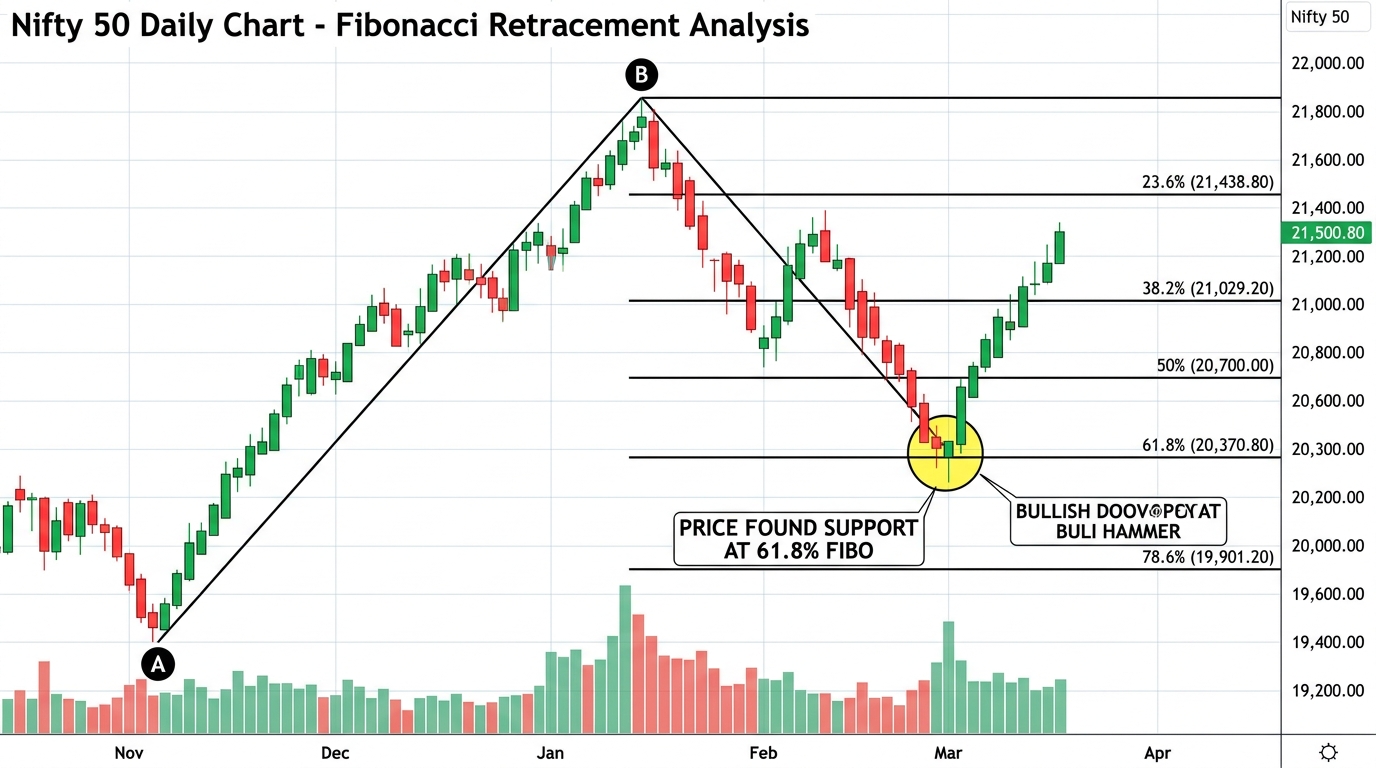
| 61.8% (Golden Ratio) | The most important level — ‘golden retracement zone’ | |
| 78.6% | Deep retracement — trend may be weakening | |
| 100% | Full retracement — original move completely reversed | |
| Golden Ratio: The 61.8% level (1 divided by 1.618) is the Golden Ratio and the most respected Fibonacci level in trading. In Indian markets, Nifty 50 has historically found significant support at the 61.8% retracement level during major corrections. | ||
How to Draw Fibonacci Retracement
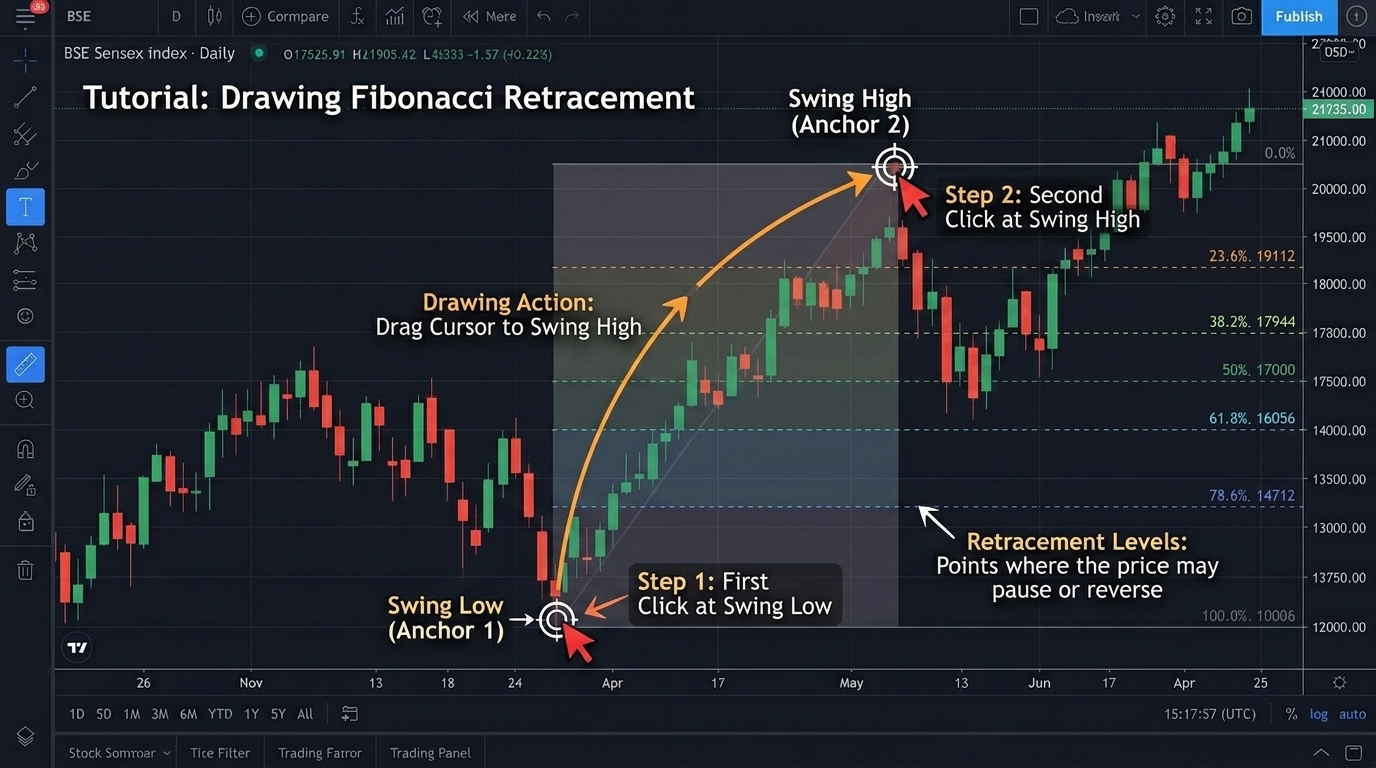
Drawing Fibonacci correctly is critical. The tool is available on all Indian trading platforms — Zerodha Kite, Upstox, TradingView.
- Identify a clear swing move — either a swing low to swing high (for uptrend retracements) or swing high to swing low (for downtrend retracements).
- In an uptrend: Click the swing LOW first, then drag to the swing HIGH. The retracement levels will plot downward from the high.
- In a downtrend: Click the swing HIGH first, then drag to the swing LOW. The extension levels plot upward from the low.
- Key rule: Use significant swing points — major pivots on daily or weekly charts. Minor pivots on small timeframes give unreliable levels.
Key Fibonacci Applications
1. Retracement Support During Uptrends
After a strong move up, price typically pulls back to a Fibonacci level before resuming the uptrend. The 38.2%, 50%, and 61.8% levels are the most commonly used entry zones for buying corrections in trending Indian stocks.
| India Application: After every Union Budget rally or post-RBI policy up-move in Nifty, look for the first meaningful pullback to reach 38.2% or 50% Fibonacci. These have historically been excellent swing buying opportunities. |
2. Fibonacci Confluence Zones
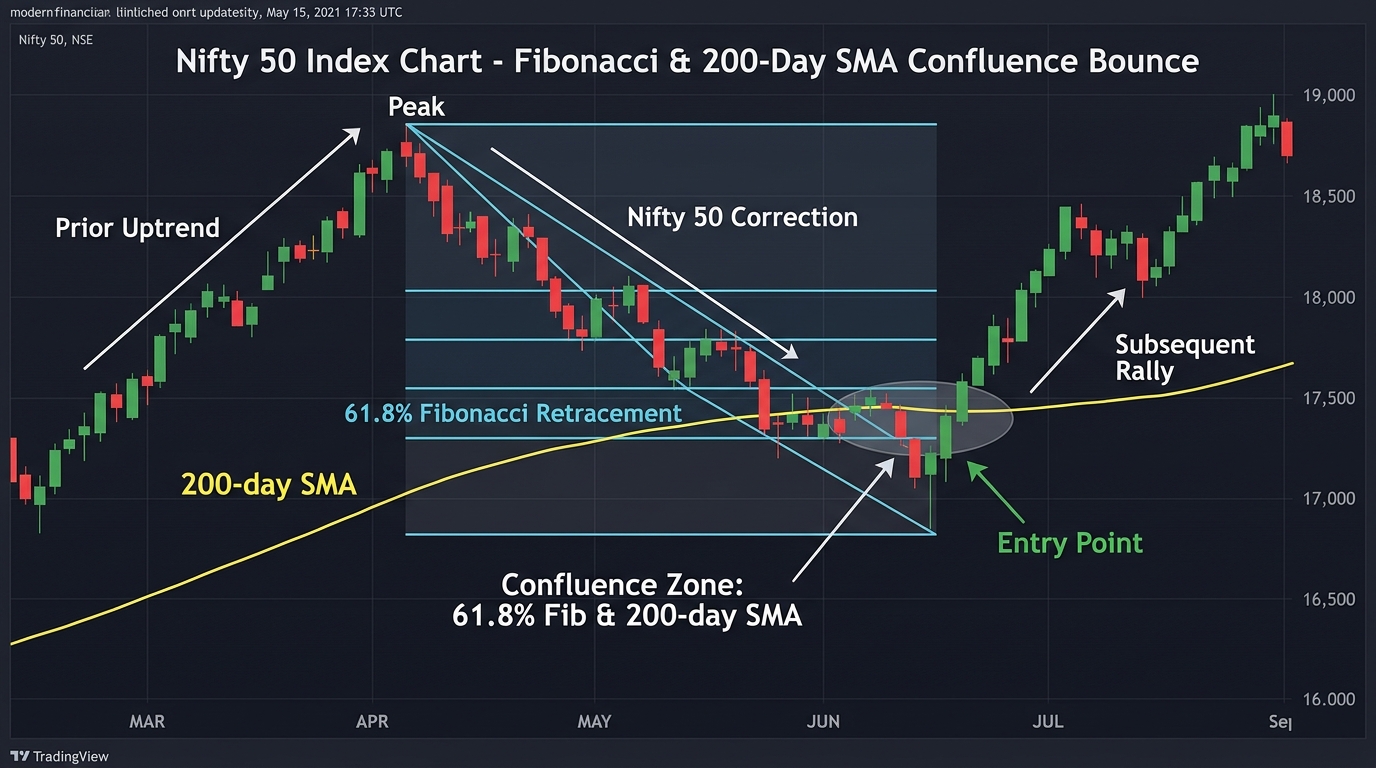
The strongest support and resistance levels occur where Fibonacci retracement coincides with other technical levels — moving averages, previous support/resistance, trendlines, or round numbers (like Nifty at 20,000 or 22,000). These confluence zones are extremely powerful.
- Fibonacci 61.8% + 200-day SMA = Very high probability support zone
- Fibonacci 50% + previous breakout level = Strong re-entry zone
- Fibonacci 38.2% + rising 20 EMA = Continuation entry in strong uptrend
3. Fibonacci Extension (Price Targets)
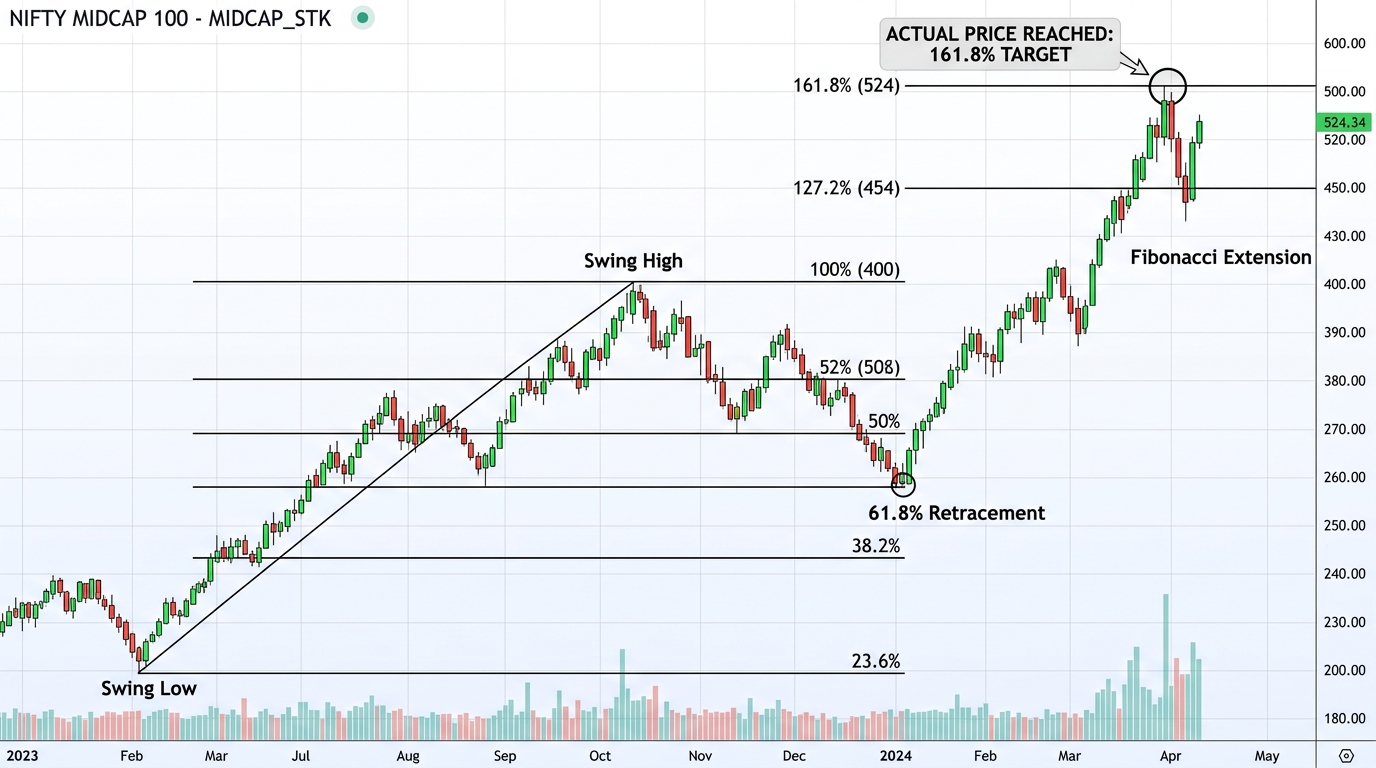
While retracement helps find entry levels, Fibonacci Extension helps set profit targets after the retracement bounce. Common extension levels are 127.2%, 161.8%, and 261.8% of the prior move.
- 8% extension is called the ‘Golden Extension’ and is the most commonly used target
- In strong Nifty momentum phases, 161.8% targets have been hit repeatedly
4. Fibonacci on Different Timeframes
Higher timeframe Fibonacci levels carry more weight. A 61.8% retracement on the monthly chart is far more powerful than the same level on a 5-minute chart. Indian positional traders draw Fibonacci on weekly and monthly charts to identify major zones.
| Monthly Fibonacci | Major long-term support/resistance zones — investor level |
| Weekly Fibonacci | Positional trading entries and exits |
| Daily Fibonacci | Swing trading — most commonly used timeframe in India |
| Hourly Fibonacci | Intraday entries within the day’s range |
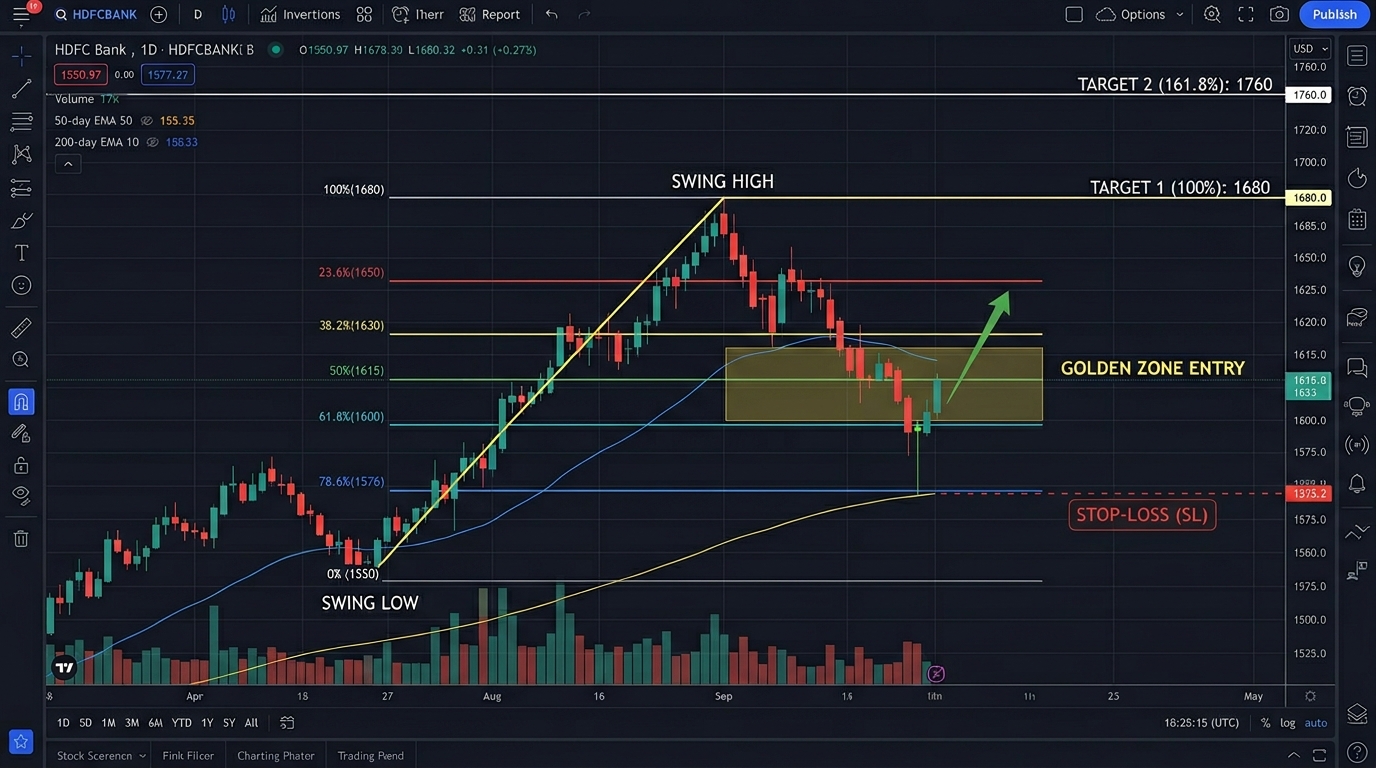
Fibonacci Strategy: The Golden Zone Entry
This is one of the most-used Fibonacci setups by Indian professional traders:
- Identify a strong trending stock (above 50 EMA and 200 SMA, good fundamentals preferred).
- Wait for a meaningful correction to begin.
- Draw Fibonacci from the last major swing low to the recent swing high.
- Wait for price to reach the 50%-61.8% zone (the ‘Golden Zone’).
- Look for a reversal candlestick pattern (hammer, engulfing, doji) at the zone.
- Enter long with stop-loss just below the 78.6% level.
- Target: previous high (100%), then 127.2% and 161.8% extensions.
Fibonacci on Indian Indices — Historical Examples
Nifty 50 has respected Fibonacci levels remarkably well at major turning points:
- COVID crash 2020: Nifty retraced to the 78.6% level of the 2016-2020 bull run before the historic recovery
- 2022 correction: Nifty 50 found support near the 50% retracement of the 2020-2022 bull run at approximately 15,600
- Post-Budget dips: The 38.2% retracement has repeatedly provided a buying opportunity after Budget Day rallies
Common Mistakes to Avoid
- Drawing Fibonacci from the wrong swing points — always use the most significant recent pivot highs and lows.
- Treating Fibonacci levels as exact price points rather than zones. Price rarely turns at exactly 61.8% — give a buffer of 0.5-1% around each level.
- Using Fibonacci in isolation. The most reliable setups occur when Fibonacci confluences with other indicators.
- Drawing too many Fibonacci levels on a chart — it creates confusion. Stick to the most recent significant swing for the timeframe you are trading.
Summary
| Key Takeaway: Fibonacci Retracement is a powerful tool for finding high-probability entry zones during corrections in trending markets. The 38.2%, 50%, and 61.8% levels are the most important. Always look for Fibonacci confluence with moving averages, trendlines, or volume-based levels for the strongest signals in NSE/BSE markets. |
Responses